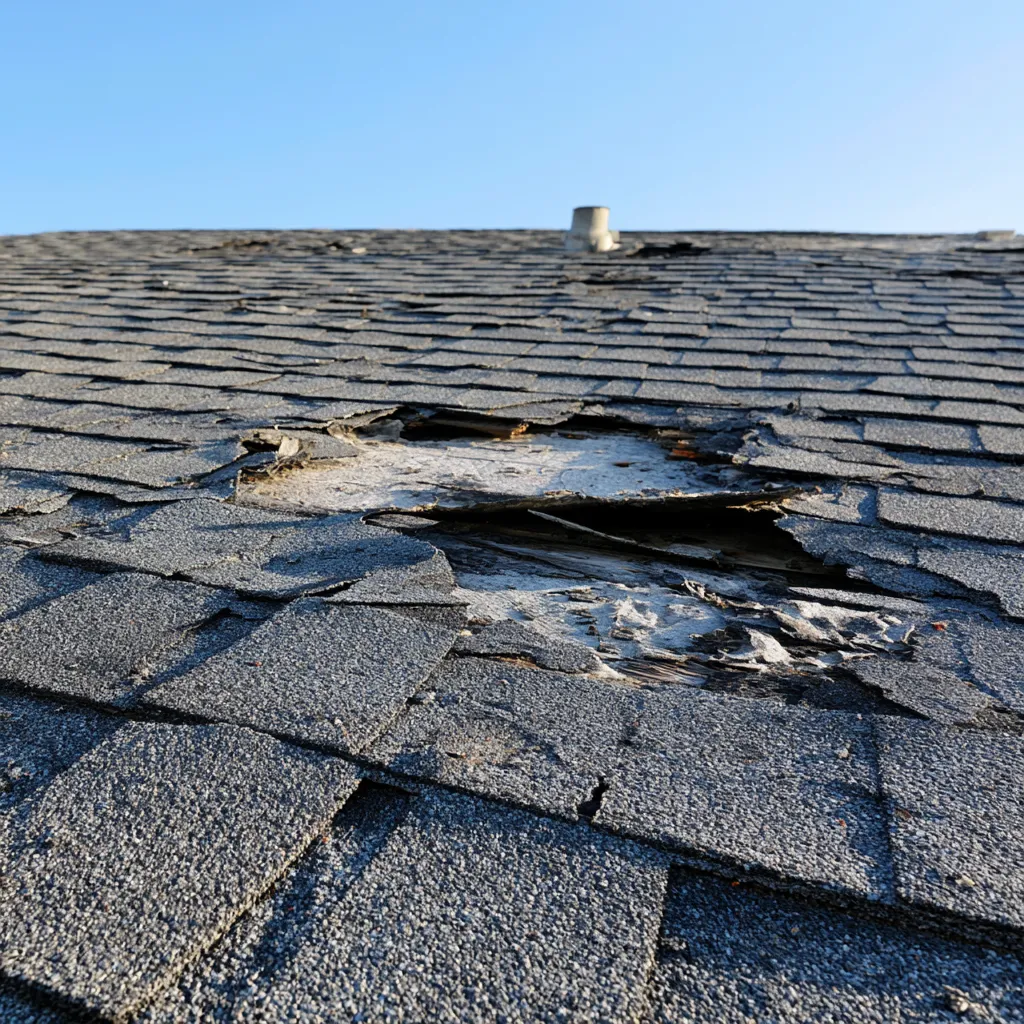
A Washington County hailstorm rolls through, the noise on the roof finally quits, and a few days later a flyer on the door says your roof is totaled and the clock is ticking. The honest truth is quieter than that. Not every storm that shows up on the county record actually leaves a claim on your particular roof, and a hail damage roof claim in Tontitown, AR is worth filing only when the damage is real. The first question is not how to file. It is whether there is anything to file at all. A straight read matters more here than a sales pitch. A good local roofer looks at what the hail actually did, separates real storm damage from the ordinary wear a roof collects with age, and tells you plainly which one you are looking at. Here is an honest homeowner guide to that call: when a hailstorm is not a claim, how real damage differs from wear, and what happens when the damage does turn out to be one. The fuller roof claim walkthrough sits alongside this.
When a hailstorm is not a claim
A hail report on the county map is not the same as damage on your roof, and that gap trips up a lot of homeowners. Over a recent four-year window the Washington County record logged 20 hail days and more than 50 hail reports, with the biggest stone measured at two inches across, hen-egg-sized, back in June 2023. Those figures say the area is busy, not that a stone the size of an egg landed on your slope. A storm can pass a mile north and leave your roof untouched, which is the first reason to get a read before you assume a claim.
An insurance policy is written for sudden, accidental damage from a specific event, not for a roof that has simply reached the end of its life. When a roofer finds nothing the hail actually caused, filing a claim with nothing behind it wastes your time and can work against you, and it is not something a straight roofer will talk you into. The honest starting point is that a claim is worth opening only when the damage is real and tied to a storm, and a dated storm inspection is how that gets settled one way or the other.
Real storm damage versus ordinary wear
Real hail damage and ordinary wear can look alike from the driveway, which is exactly why the read has to happen up close. Hail leaves a specific set of marks: a bruise where a stone crushed the shingle mat, fresh granule loss where the stone knocked the protective surface off the asphalt, and dents in the soft metal on vents, valleys, and gutters. Those marks are scattered, recent, and random, and they line up with the size and direction of the stones that fell.
Ordinary wear tells a different story. An aging roof shows even, all-over granule loss, curling or brittle shingles, and worn spots where the sun always hits hardest, none of it tied to a single storm. On the older homes near the founding core an aging roof is common, while the newer east-side builds are mostly still young, so the read is different house to house. A roofer working slope by slope can usually tell the two apart, because hail damage is sudden and patterned while wear is gradual and everywhere. The storm damage page goes deeper on what each one looks like.
What a straight roof read looks like
An honest read is a look, a plain call, and no pressure to do anything you do not need. A local roofer gets on the roof, checks the slopes and the metal, dates any real damage to the storm that caused it, and hands you a written finding in plain language: what the hail did, what is only age, and what, if anything, is worth acting on. The point is to tell you where the roof stands, not to talk you into a job.
A read like that is useful no matter which way it comes out. If the roof is fine, you have a dated baseline the next storm gets measured against. If the damage is real, you have the start of a record and a clear choice about what to do with it. Either way you are deciding from a straight answer rather than from a flyer left on your door.
When the damage is a real claim
When the damage is real and tied to a storm, the honest next step is documentation, and then the decision is yours. A roofer photographs every affected slope, sizes the dents against the hail, notes the storm date from the county record, and writes a scope listing what a proper repair or re-roof needs. That record is what a carrier reads, and it is what turns a claim from an argument into a shown fact. The roofer documents and does the work; the carrier decides the claim, and a straight roofer never files it for you or promises an outcome.
Arkansas does not hand you a special state clock for a hail roof claim, so the timing is set by your own policy. Unlike Oklahoma next door, which under its HB 3495 stretches some wind and hail roof claims by law, Arkansas leaves the deadline to your policy, commonly a year or two from the date of loss and sometimes shorter. Read your policy, do not sit on real damage, and treat your insurer and the Arkansas Insurance Department as the authorities rather than a neighbor's rule of thumb.
Here is the short version once real damage is confirmed:
- Document first: photograph every affected slope and note the storm date before anything else.
- Get the dated read: a local roofer separates real hail damage from ordinary wear and writes the finding down.
- Check your policy window: Arkansas leaves the deadline to your own policy, not a state clock.
- File only if it is real: open the claim yourself, in your own name, once the read confirms it.
- Keep the record: dated photos and the written scope are what the carrier reads.
Not sure whether last week's hail actually did anything to your roof? Send Tontitown Select Roofing your address, and a local roofer will read every slope, separate real storm damage from ordinary wear, and give you a straight written answer, at no cost.
Get a straight read on the damage Call (479) 333-8376